
How Can I Yump?
The Crisis You Didn't Know You Were Having and How to Move Beyond it

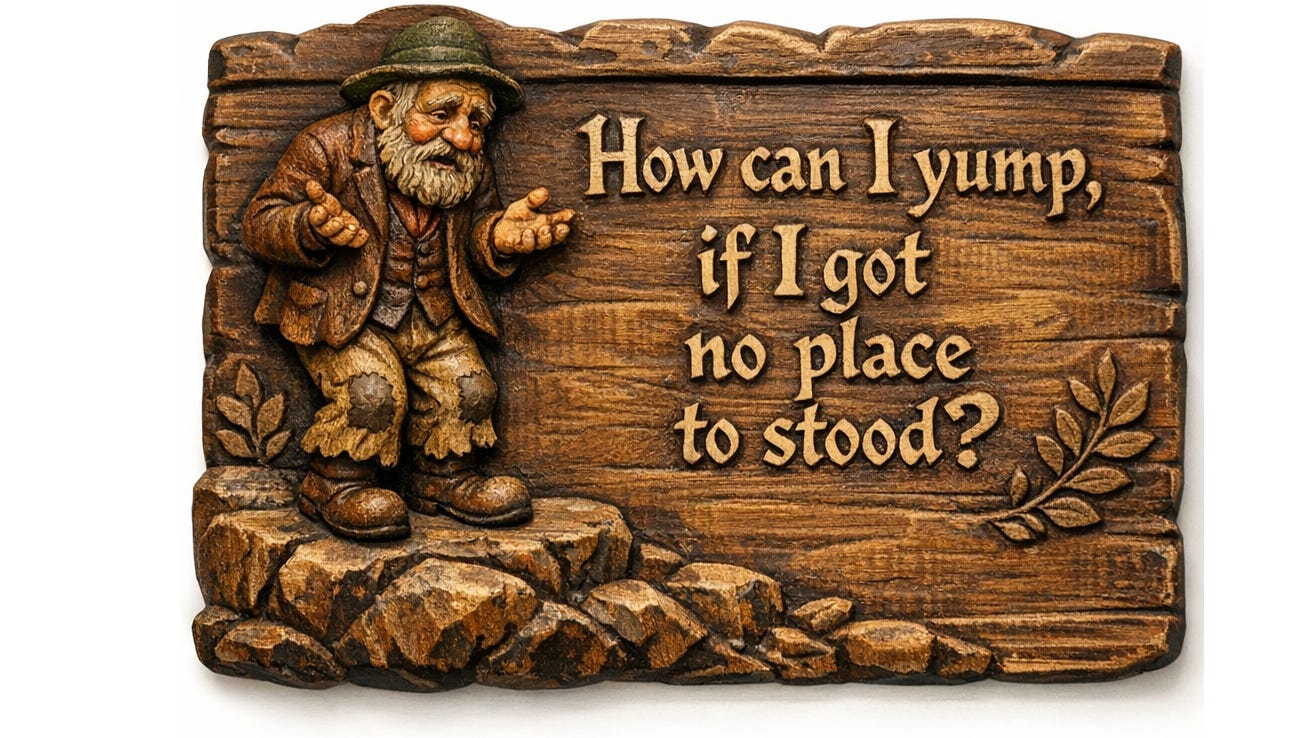
When I was a little boy I found an old plaque in the garage and asked if I could have it in my room. It was a two dimensional plaque made to look like a wood carving in the folk style of the 1920s and 30s. It was made from some type of hard resin. The subject was an old man with a green felt hat standing on a rock, and beside him carved in the wood were these words, “How can I yump, if I got no place to stood?” For my serious young mind, this was like a kōan, those puzzling questions used in Zen Buddhism to provoke deep reflection and awaken insight.
I ruminated on it for months and then asked my mother what it meant and she said it was a phrase Swedish immigrants used to say and people found it humorous and insightful. “How can I jump if I have no place to stand,” she continued, “they were new to Canada and didn’t have much.”
“Ok,” I thought, “but why make a plaque about that?” I thought there must be more to it — “what does it REALLY mean?” I wondered. My father said, “It’s about your view of things, you have to have a firm foundation in your own faith before you can look at other perspectives.” Ok, that sounded closer to what I was looking for, but seemed a bit too spiritualized.
I eventually decided that what it meant was that before you do anything important, you need a reliable, stable, firm place to start from. For the immigrants it was probably money, a better grasp of English, and opportunity, all things they were short on because of their status.
But like all good kōans, there is no one simple answer, because why was jumping involved? My dad’s theory that it was about faith seems to be born out in some conversations I found online. One group reminisced about a teacher they had had, Mr. Sanderson, a fondly remembered sage from childhood.


I finally understood the saying when in my teens I was fishing on Duhamel Creek, an old creek with many rounded rocks and boulders that flows down a valley in the mountain behind my childhood home.
I was at the mouth of the creek where it spilled into the Kootenay Lake, and I wanted to get across to the other side but my feet were slipping on the rocks and when I tried to jump, they went out from under me and I landed on the wet slippery stones, bruising my knee. I eventually found a bigger rock upstream that rose above the slime and algae coating the other rocks. From that rock I launched myself across the creek and landed on the other side safe and dry. I had literally fulfilled the wording of the parable, but I had also apprehended it’s deeper meaning.
Sometimes to get to where we want to go, we need to leap, not a leap in the dark but a calculated leap, a considered risk for an in-sight reward. But we can’t make that leap without firm footing.
Preparing for your Yump
For many of us these days, our life is a flat plain of slippery rocks. How can we jump across the stream to something new, or something better, or a place to explore, if we have no dry solid rocks to jump from?
John Vervaeke argues that this common experience is evidence of a profound meaning crisis. It is marked by a sense of disconnection, alienation, and loss of purpose. But he’s careful to show this isn’t just a passing problem or prevailing mood; it has deep historic roots.
The Historical Roots of the Meaning Crisis
Vervaeke outlines the history of “meaning-making” that began in and around ancient Greece with the intellectual accomplishments of Socrates, Plato, Aristotle and other thinkers who explored the joys and pitfalls of rational dialogue and ethical living. Central to their framework was the idea of forms, universal ideals that formed the basis of all reality.1
Christianity inherited the Platonic tradition, at least in the West, but moved meaning and meaning making from relationships to participation in a wider community. In simple terms the move was from an intimate and experiential relationship between an elder and her protégé, between a master and apprentice, or rabi and disciple to a more institutional experience. This corresponded with the culture shifted from agrarian focused narratives to those of the city and church.
As literacy expanded and ideas were more easily circulated there arose a growing separation between platonic schools of thought and a new model championed by William of Ockham. William of Ockham rejected the idea of real forms in favor of a more materialistic conception that only individual substances and qualities truly exist.
Ockham complained that, “It is futile to do with more things that which can be done with fewer” and this was later conceptualized as Ockham’s razor, “other things being equal, simpler explanations are generally better than more complex ones." Or, as I heard it, “cut through the overly elaborate explanations to the elegantly simple ones and you will be close to the truth.”
The Protestant Reformation followed Ockham with it’s emphasis on private and individualized inner life and a shift from authority in the church and academic institutions, to the sturdy sensibilities of the common person.
In Academia the Scientific Revolution produced a “disenchanted” universe — a cosmos of mechanism rather than meaning.
Following the development of a robust and effective scientific method, the Enlightenment tried to replace religious meaning with reason alone, but Vervaeke argues this was insufficient and while Romanticism tried to recover what was lost through feeling and nature, it ultimately failed as science combined with free market values to demonstrate the power of a reductionistic methodology.
Church and State
Now, culturally, we are left with dying churches where meaning can still be found by some, but where many people feel out of place because of the denial of well established truths such as evolution, virology, and neurodiversity.
To the cultural disconnect Vervaeke adds the cognitive disconnect. He argues the crisis is also a crisis in our ways of knowing. He distinguishes several types of knowing:
Propositional knowing — knowing that (facts)
Procedural knowing — knowing how (skills)
Perspectival knowing — knowing what it’s like (first-person experience)
Participatory knowing — a deep sense of belonging to and being at home in reality
The diagnosis of our ill is fairly straight forward: Modern culture has become obsessed with propositional knowledge (data, information) at the expense of the others — especially participatory knowing, which is the foundation of all genuine meaning.
Let me emphasis that point:
Participatory knowing is the foundation of all genuine meaning.
He also emphasizes a term he coined, relevance realization, referring to our cognitive capacity to discern what matters, what to pay attention to, and how things connect. When relevance eludes us, we develop mental disorders, often marked by maladaptive survival strategies that keep us stuck in meaningless cycles of anxiety or depression.
While cognitive behavioral therapies can help stabilize people, and while other therapeutic interventions such as medication and trauma therapy can reduce symptoms and provide relief from highly reinforced beliefs, these interventions do not provide access to meaning. Vervaeke offers 5 options that can help with this:
Recover participatory knowing — not just believing things about the world, but cultivating a felt sense of belonging to reality. This is where practices like meditation, contemplation, and philosophical dialogue can help.
Transformative experience — meaning isn’t just found, it’s made through genuine self-transcendence. He points to Neoplatonists, the Stoics, and Buddhism to argue we need practices that change not just what we think, but who we are — what he calls “self-transcendence.”
The “Axial Age” as a model — he looks to the great transformations of the Axial Age brought about by the Buddha, Socrates, and the Hebrew prophets as examples of cultures that successfully navigated meaning crises. They developed new practices or inner technologies for transforming consciousness.
Adopt the model not the solution — Vervaeke resists the move to adopt ancient solutions as they are because in many ways they have ceased to work in our modern age. He pushes for a non-dogmatic view of spiritual life and this resonates with many who have left traditional religions that stifle thought and imagination. It seems that a wholly new kind of religious experience is needed.
Nonduality and flow — he puts weight on personal experiences like flow states and gnosis, where the subject/object divide created by Ockham soften and one feels genuinely at home in what one is doing.
In Summary
We are experiencing a crisis: The cognitive and cultural frames and narratives that once connected us to each other and to a felt sense of meaning, purpose, and belonging have unraveled as mechanistic and reductionistic models have proved more reliable at making things. Doing has become the focus and productivity has become the measure of worth.
Vervaeke’s Solution: Build an ecology of practices — draw on ancient wisdom traditions and modern cognitive science to restores participatory knowing, enables genuine self-transcendence, and connect to a sense of being at home in reality. He describes himself as a Neoplatonist and nontheist, revealing his rejection of Ockham’s razor as a basis for meaning, and a reimagining of the forms with the benefit of cognitive science and over 2 thousand years of collective thought.
My Perspective
I accept Vervaeke academic work. I’ve found no other scholar with as comprehensive a grasp of history and modern science as him. I arrived at similar conclusions about the crisis but through less rigorous means. I knew that much of my faith in Christianity was at odds with my acceptance of scientific truths, but didn’t know how to harmonize the two.
Like many I had to admit the efficacy and power of the scientific method, not just to produce valuable tools, products, and treatments, but also to keep us from falling into various fallacies and self-deceptions.
My work continues to integrate what I know to be true from science, philosophy, and religion, and to construct my own ecology of practice with the idea of using imagination, diologos, and other intuition-based methods to uncover a new framework that can work to provide meaning to myself and others. We are, I believe at a new axial age, and my tradition, Christianity, must evolve or fail.
How this Relates to my Coaching Practice
Carl Jung’s bold intuitive and experiential project continues to ripple through our culture generating new therapeutic techniques and insights despite how behaviorism and reductionism have dominated academia for the last 40 years, riding as they do on empiricism, critical thinking, and the success of the scientific method.
I embrace all that science and technology have to offer, and do not want to slip into the woo woo world of pseudoscience and superstition. But I also recognize that there is a resurgence of interest in the world of forms, be it through Neo-Platonism, panpsychism, or idealism. I lean more towards Philip Goff’s view of panpsychism that holds that the physical world is fundamental, but its intrinsic nature is consciousness.
My goal is to use Jung’s discoveries, as well as those of subsequent thinkers to balance the current extreme positions of either outright rejection of science, or outright rejection of religion and philosophy.
As a partner with my clients I use curiosity, openness, and dialogos to explore each person’s unique path and enjoy the insights that come from collective intelligence. I use my sensitivity and intuitive kindness to appreciate and support each person’s work to know themselves better and find new and lasting meaning in their lives.
A Place to Yump
In conclusion, we all need a secure place from which to jump into new opportunities, new ways of seeing, and new meaningful experiences. The coaching relationship is such a place. If you would like to see if a session might work for you, please reach out to me for a free 15 minute Q and A about what working with me could like like. For more information visit the FAQ page Is Still Stream Coaching Right for Me: